





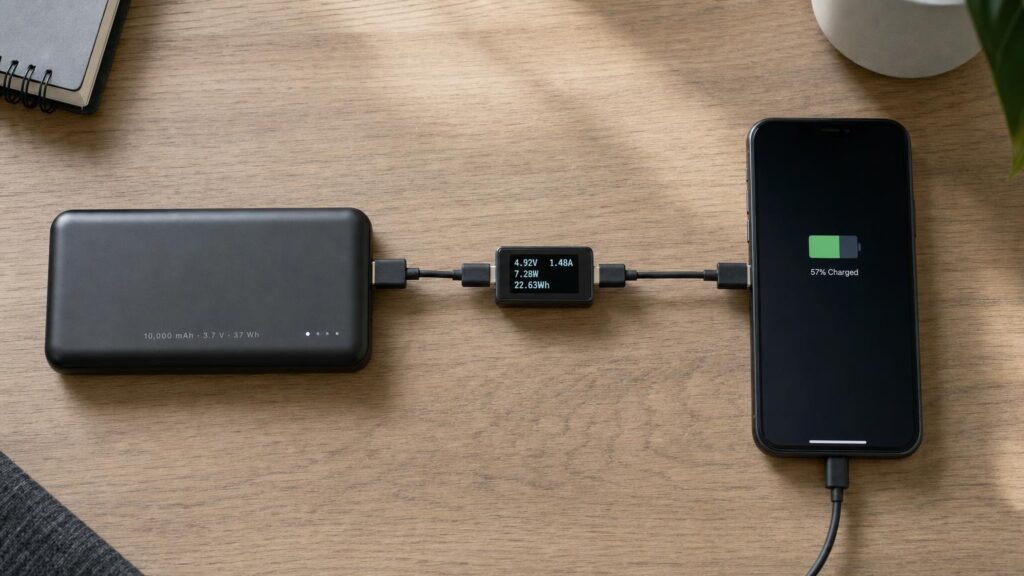
A power bank labelled 10,000 mAh will not deliver 10,000 mAh directly into a phone. That apparent shortfall is usually not evidence of a fault. The number on the casing commonly describes the charge stored by the power bank’s internal cells at their own nominal voltage, while phones and other USB devices receive power at a different voltage.
Moving energy from the internal cells to a device requires voltage conversion, regulation and control electronics. Some energy also becomes heat in the power bank, cable and receiving device. Understanding these stages makes it easier to compare capacities, estimate likely performance and avoid confusing a high charging wattage with a large energy reserve.
Why the number on the label is not the power you receive
A milliamp-hour rating describes electrical charge, not energy by itself. Its meaning depends on the voltage at which it is measured. Power bank capacity is typically based on the internal lithium-based cells, whereas USB output may operate at 5V, 9V or another negotiated level.
This matters because the power bank cannot simply pass its labelled charge straight to the USB port. It must convert the cells’ changing voltage into a stable output suitable for the connected device. Even with efficient electronics, that process cannot deliver every unit of stored energy to the device battery.
The label is therefore best treated as a description of internal cell capacity under specified conditions. It is not a promise that the same mAh figure will appear at the output connector or be stored by a phone.
Milliamp-hours and watt-hours measure different things
Milliamp-hours, abbreviated to mAh, measure charge. Watt-hours, or Wh, measure energy. Energy is usually the more useful basis for comparing batteries that operate at different voltages.
The basic relationship is:
Watt-hours = amp-hours × volts
Because 1,000 mAh equals 1 Ah, a power bank marked 10,000 mAh has a charge capacity of 10 Ah. If its cells have a nominal voltage of 3.7V, the corresponding energy is:
10 Ah × 3.7V = 37 Wh
This is an illustrative calculation rather than a universal specification. Cell chemistry, nominal voltage and the manufacturer’s rating method can differ. The important point is that the voltage must be included.
If that same 37 Wh were converted to 5V with no losses, it would correspond to 7.4 Ah, or 7,400 mAh, at the output. Real conversion is not lossless, so the energy reaching the cable and device would be lower still. Nothing has mysteriously disappeared merely because the output mAh number is smaller – the comparison has moved to a different voltage.
Internal cell voltage versus USB output voltage
Lithium-based cells inside a power bank generally operate across a voltage range, with specifications often using a nominal value to describe them. Standard USB charging begins at a higher regulated output voltage, and compatible USB-C systems may negotiate still higher voltages.
The power bank therefore uses conversion circuitry to raise and regulate its cell voltage. At a higher output voltage, the same amount of energy corresponds to fewer amp-hours. This is why mAh values should not be compared across voltages without first converting them to watt-hours.
Higher-voltage output does not itself create or destroy the stored energy. It changes the relationship between voltage and current. A compatible device may use a higher voltage to receive more power without requiring a proportionate increase in cable current, but the total energy still comes from the power bank’s finite Wh reserve.
Where energy is lost during charging
No battery-to-battery charging process is perfectly efficient. Losses can occur at several points:
- Voltage conversion: The circuits that transform cell voltage into regulated USB output consume energy and generate heat.
- Power bank electronics: Displays, status lights, protection systems and control chips draw a small amount of power while operating.
- Cable and connector resistance: Current passing through conductors and contact points creates heat. Thin, long, damaged or poorly connected cables can increase this loss.
- Device charging circuitry: A phone must convert incoming USB power into the voltage and current required by its battery. That stage also has losses.
- Battery behaviour: Charging typically becomes more controlled as a battery approaches full, and the device continues to power its own electronics during the process.
Efficiency varies with output voltage, current, temperature, electronics design and operating conditions. A single percentage should not be assumed for every power bank or every charging session. A credible capacity rating can still produce noticeably less usable output than a simple mAh comparison suggests.
Why phone battery capacity is not a simple recharge counter
Dividing a power bank’s labelled mAh by a phone battery’s mAh may look like an easy way to predict the number of recharges. It is unreliable because the two ratings may refer to different cell voltages and because energy is lost between them.
A better starting point is to compare watt-hours. Convert both batteries to Wh using their stated or documented voltages where available, then recognise that only part of the power bank’s stored energy will reach the phone battery.
Even a watt-hour comparison gives an estimate rather than a guaranteed recharge count. Results also depend on:
- whether the phone is being used while charging;
- screen brightness, mobile reception and background activity;
- the age and condition of both batteries;
- temperature and charging-rate management;
- the power bank’s shutdown threshold and retained reserve;
- the phone’s battery reporting and protective charge limits.
A phone that is streaming video or providing navigation may consume a meaningful portion of the incoming energy before it reaches the battery. Charging with the screen off and light background activity will usually produce a different result.
USB-C Power Delivery changes speed, not stored energy
USB-C Power Delivery, commonly called USB-C PD, allows compatible equipment to negotiate supported voltage and current combinations. This can enable higher charging power than basic USB operation, but it does not increase the power bank’s stored capacity.
Power and energy answer different questions:
- Watts indicate charging power – the rate at which energy can be delivered at a particular moment.
- Watt-hours indicate energy capacity – approximately how much energy is stored.
A high-wattage power bank may charge a compatible device quickly but have a modest energy capacity. A lower-wattage model may store more energy yet take longer to deliver it. Shoppers should therefore examine both figures rather than treating the largest watt number as proof of longer runtime.
Faster charging can also produce more heat under some conditions, and conversion efficiency may vary at different power levels. The device controls what it requests, so a power bank’s maximum output is a ceiling rather than a rate that every connected product will use.
Ports, cables and devices can limit real-world output
A USB-C connector describes a physical interface, not a guaranteed charging rate or feature set. The power bank, cable and receiving device must all support the relevant charging protocol and electrical requirements for a particular mode to operate.
A device that accepts less power than the bank can provide will charge at the device’s limit. Likewise, a cable that is not suitable for the requested current or mode may result in a lower negotiated rate. Cable resistance can also reduce voltage at the receiving end and turn some energy into heat.
When evaluating cables, consider their supported power level, current capability, length and condition. Loose connectors, damaged insulation or unusually warm plugs are reasons to stop using a cable and inspect the equipment. A cable marketed mainly for data use should not automatically be assumed to support every high-power charging mode.
Protocol compatibility matters too. Two products may both use USB-C yet settle on a basic charging level if they do not share an appropriate fast-charging profile. This affects speed more directly than total capacity, although a longer, less efficient charging session can also influence usable energy.
Shared-port limits and simultaneous charging
Headline output wattage often refers to one port operating under particular conditions. When two or more devices are connected, a power bank may divide its available output, apply a separate combined limit or renegotiate the charging profiles on individual ports.
Three specifications should be kept separate:
- Per-port maximum: The most one connector can provide when the relevant conditions are met.
- Combined output maximum: The total power available across active ports.
- Stored capacity: The power bank’s finite energy reserve, preferably expressed in Wh.
Connecting more devices does not increase the stored capacity. It usually drains that capacity more quickly, while each device may receive less power than it would when connected alone. Some power banks also briefly interrupt or renegotiate output when another cable is attached. Buyers planning to charge several devices should inspect the multi-port output table rather than relying on the largest number printed on the front of the packaging.
How to interpret specifications before buying
A useful comparison begins with the devices you intend to charge. Note their charging protocols, accepted power levels and approximate battery energy where that information is available. Then assess each power bank in the following order:
- Find the watt-hour capacity. Wh provides the clearest like-for-like energy comparison. If only mAh and nominal cell voltage are given, convert amp-hours to watt-hours.
- Look for rated output energy or capacity. Some specifications distinguish internal cell capacity from usable output under stated test conditions. Check the voltage and conditions attached to any output-capacity figure.
- Check supported output profiles. Confirm that the power bank and intended device share suitable charging standards and voltage-current combinations.
- Separate input from output. Input wattage concerns how quickly the power bank itself can recharge. It does not describe how quickly it charges another device.
- Read the port table. Compare single-port limits with combined limits and note how output changes when ports are used together.
- Check cable requirements. The included cable, if any, may not be suitable for every advertised mode. Match cable capability to the intended voltage, current and protocol.
- Allow for normal losses. Do not treat the calculated internal Wh as energy that will all arrive in the receiving battery.
Physical size, weight, charging speed and capacity involve practical trade-offs. A larger energy reserve may be useful for travel or several devices, while a smaller bank may be easier to carry. The most suitable choice is not necessarily the one with the biggest mAh figure, but the one whose energy capacity, output profiles and port behaviour match the intended use.
Set realistic expectations for usable capacity
A power bank’s labelled mAh figure usually refers to charge stored in its internal cells, not the charge ultimately deposited in a phone. To interpret it properly, include the cell voltage and compare energy in watt-hours.
From there, allow for voltage conversion, electronics, cable resistance and the receiving device’s own charging losses. Treat USB-C PD wattage as a measure of potential charging speed, not stored energy, and check whether that headline power remains available when several ports are active.
Using watt-hours for capacity comparisons and watts for charging-rate comparisons removes much of the confusion. It also produces more realistic expectations than dividing one mAh label by another.
Continue exploring on Frowse
Best Sellers · Top Rated · Best Value · Under £50 · Fresh Finds · Premium Picks
Discover More Frowse Insights
- Why Baking Trays Warp in the Oven and Sometimes Flatten Again
- Inside a Stand Mixer: How Gearing, Planetary Action and Bowl Geometry Work Together
- AGM, EFB and Flooded Car Batteries: Why the Right Size Is Not Enough
- Why a Tripod’s Load Rating Does Not Tell You How Steady It Will Be
- Why Dimmable LED Bulbs Flicker, Buzz or Refuse to Dim Properly