





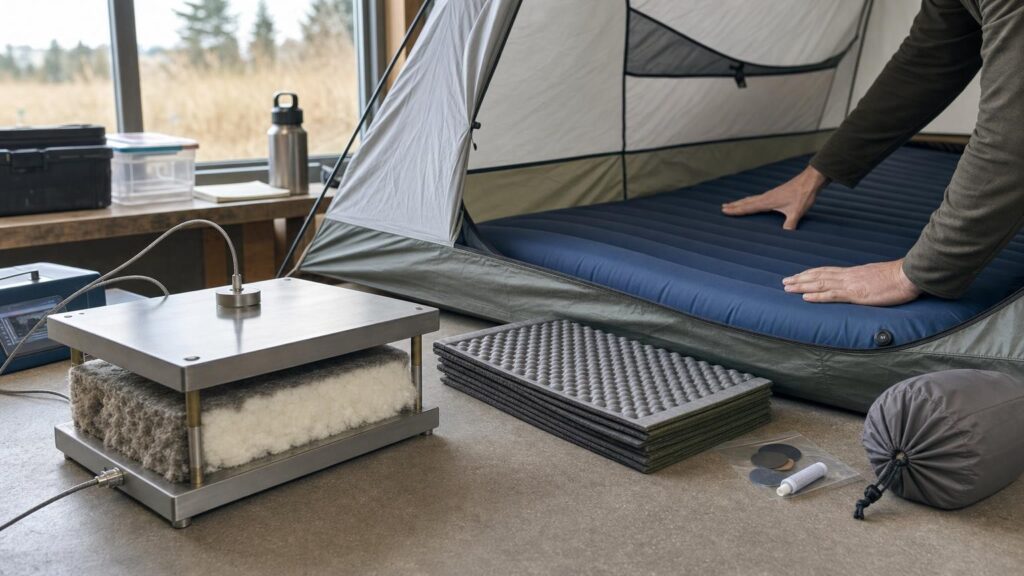
A sleeping mat does more than soften hard or uneven ground. It also limits heat loss from your body into the surface below. R-value is the most useful number for comparing that insulating function, but it cannot tell you whether a mat will feel comfortable, fit inside your tent, survive rough use or pack down conveniently.
Understanding what sits behind the rating helps separate genuine thermal performance from visible features such as thickness. It also makes it easier to judge the practical trade-offs between air mats, foam mats and hybrid designs.
R-value is useful – but it is not a complete warmth rating
R-value expresses resistance to heat flow. For sleeping mats, it indicates how effectively the mat resists heat moving from the sleeper towards the ground under controlled test conditions. A higher number means greater thermal resistance.
That makes R-value valuable as a comparison tool. Unlike broad descriptions such as “three-season” or “winter”, it provides a measured property rather than a loosely defined usage label. If two mats have credible ratings produced using the same recognised test approach, their numbers offer a useful indication of their relative insulation.
R-value is not, however, a direct temperature rating. It cannot guarantee comfort at a particular overnight temperature because warmth depends on the entire sleep system, the sleeper and the environment. Wind exposure, damp ground, frozen soil, shelter, clothing, sleeping bag insulation and individual sensitivity to cold can all change the experience.
The rating also says nothing about cushioning, noise, stability, durability or ease of inflation. It is best treated as an important filter rather than a complete verdict.
What a standardised R-value actually measures
In a controlled test, a mat is placed between surfaces maintained at different temperatures. The test assesses how much energy is required to sustain that temperature difference through the mat. A mat that allows less heat to pass has greater thermal resistance and therefore a higher R-value.
Standardisation matters because mat construction can be surprisingly complex. Looking at thickness, weight or the amount of visible foam does not provide a reliable comparison on its own. A consistent test method allows very different structures to be assessed according to the same basic thermal property.
Laboratory consistency does not remove every real-world variable. Inflation pressure can affect the structure of an air mat, and a sleeper’s weight can compress some materials. Ground contours may create gaps or pressure points that are not represented perfectly by a flat test. Manufacturing tolerances and differences between test methods can also complicate very close comparisons.
For shopping purposes, large differences between credible ratings are generally more informative than tiny differences. A small numerical advantage should not automatically outweigh a better fit, more suitable construction or easier repair.
How sleeping mats slow heat loss to the ground
A mat does not generate heat. It retains more of the warmth already produced by the sleeper by slowing several forms of heat transfer.
Trapped air
Still air is a useful insulator. Air mats create separation between the body and the ground, but simply enclosing a large volume of air is not enough. If air can circulate freely inside the mat, warmer air can move away from the sleeper while cooler air replaces it. This internal movement transfers heat more readily than air held in small, stable spaces.
Baffles and chamber structures
Internal baffles divide an air mat into chambers. As well as shaping the sleeping surface, these structures can restrict air circulation and interrupt direct paths for heat loss. Chamber orientation and depth also influence how the mat supports the body and reacts when the sleeper moves.
Reflective layers
Some insulated air mats use reflective films or surfaces to reduce radiant heat transfer through the interior. These layers work as part of the internal structure rather than acting like a standalone source of warmth. Their effectiveness depends on their placement and on the air spaces around them.
Foam
Foam contains many small pockets that trap air and restrict its movement. Closed-cell foam keeps those pockets separate, while open-cell foam can compress and expand as air enters or leaves. Self-inflating mats typically combine open-cell foam with an airtight outer shell, providing both cushioning and insulation.
Effective mats often combine several mechanisms. The resulting R-value reflects the performance of the complete construction, not merely the presence of a particular material.
Why thickness alone can be misleading
A thick mat may offer generous cushioning without offering correspondingly high insulation. If its interior is largely one uninsulated air space, the air can move around and carry heat towards the ground. A thinner design with foam, reflective layers or carefully divided chambers may resist heat flow more effectively.
Thickness nevertheless matters for comfort. Greater depth can allow more adjustment and may prevent hips or shoulders from pressing into the ground, particularly for side sleepers. However, this is a question of load distribution and usable cushioning rather than thermal resistance alone.
The way a mat behaves under body weight is equally important. A thick but very soft mat can compress substantially at pressure points. Overinflation may keep the sleeper off the ground but create a firm, unstable surface. Consequently, the printed depth should be considered alongside R-value, internal structure and preferred firmness.
What different constructions imply beyond the number
Uninsulated air mats
These mats rely mainly on an inflated air chamber for cushioning. They can be compact when packed and may provide substantial sleeping depth, but their thermal resistance can be modest if little is done to control internal heat movement. Their feel depends heavily on chamber layout and inflation pressure.
Insulated air mats
Insulated air mats add features such as internal films, synthetic insulation or more elaborate baffles. They can combine relatively low packed volume with meaningful thermal resistance, although intricate construction may introduce more seams and internal components. Some reflective structures can also produce noticeable noise when the sleeper moves.
Self-inflating foam-and-air mats
A self-inflating mat contains compressible foam inside an airtight shell. Opening the valve allows the foam to expand and draw in air, although additional inflation may be needed to reach the preferred firmness. The foam can provide stable support and relatively consistent insulation, but it usually occupies more space when rolled than a mostly hollow air mat.
Closed-cell foam mats
Closed-cell mats do not require inflation. They are simple, quick to deploy and unaffected by punctures in the way airtight mats are. Their fixed thickness limits firmness adjustment, and they can be bulky to carry even when their weight is modest. Fold patterns, ridges and foam density influence both cushioning and packed shape.
None of these categories is automatically best. The useful question is which combination of insulation, support, packed size and resilience fits the intended journey.
The comfort factors R-value leaves out
A thermally appropriate mat can still result in a poor night’s sleep. Width and length need to accommodate the sleeper without forcing arms, feet or parts of the sleeping bag onto cold ground. The mat must also fit the tent floor alongside other occupants and equipment.
Shape affects usable space. Tapered mats can reduce weight and packed volume, while rectangular mats generally provide more room for changing position. Raised side chambers may help some sleepers remain centred, but others may find pronounced edges restrictive.
Pressure distribution is particularly important for side sleepers because body weight is concentrated around the hips and shoulders. Chamber arrangement, foam density and inflation pressure determine whether those areas remain supported. A mat that allows regular contact with the ground loses both comfort and some of its practical insulating benefit at that point.
Other considerations include surface texture, fabric feel, movement noise and stability. A slippery sleeping bag on a smooth mat may drift during the night, especially on a slightly sloping pitch. Adjustable firmness is an advantage of inflatable designs, but only within the limits needed to keep the body clear of the ground.
Durability, packed size and repairability trade-offs
Reducing weight and packed volume often involves thinner face fabrics or more intricate internal construction. That does not automatically make a mat unsuitable, but it can increase the importance of careful site selection and protection from thorns, sharp stones and abrasive ground.
An external puncture in an inflatable mat may be repairable with a compatible patch if the hole can be located and the surface can be cleaned and dried. A simple field repair can restore enough function for a trip, although a more permanent repair may be needed later.
Other failures are harder to address away from home. Problems involving a valve, welded seam, internal baffle or delaminating layer may not be accessible from the outside. Internal films can contribute insulation without much bulk, but they cannot usually be repaired like a visible shell puncture.
Foam changes the equation. Closed-cell foam cannot deflate suddenly, and local damage may not make the entire mat unusable. Self-inflating mats still rely on an airtight shell, but their foam may retain some cushioning if air is lost. The trade-off is usually greater packed volume compared with a similarly sized air mat.
Shoppers should therefore consider not only how likely damage is, but also its consequences. A compact inflatable can be appealing where every bit of pack space matters, while simpler construction may be preferable when immediate reliability and minimal repair dependence take priority.
How the mat works with the rest of a sleep system
The mat and sleeping bag or quilt perform different but complementary jobs. Insulation beneath the body in a sleeping bag becomes compressed, which reduces the amount of still air it can hold. The mat must therefore provide much of the insulation from the ground.
Clothing, shelter and ground conditions also matter. A sheltered night on dry ground is different from exposure above cold or waterlogged soil, even at a similar air temperature. Individual metabolism, fatigue and food intake can influence perceived warmth too, so another person’s experience is not a dependable temperature guarantee.
Inflation level deserves attention. Too little air may allow pressure points to touch the ground, while excessive inflation may reduce comfort and make the mat feel unstable. Adjusting pressure while lying on the mat is more informative than judging it by hand.
Mats can also be stacked. Their R-values can be treated as broadly additive, making a foam mat beneath an inflatable a practical way to increase total thermal resistance and provide some puncture protection. Real-world results still depend on the mats remaining aligned, fitting the shelter and behaving well together. Ratings derived through different test approaches may also make exact arithmetic less certain.
Use R-value as a filter, then inspect the design
Start by choosing a credible R-value appropriate to the expected ground conditions, allowing sensible margin where conditions are uncertain. Avoid translating the number into a guaranteed comfort temperature or assuming that the highest available rating is necessary for every trip.
Next, inspect how the insulation is achieved. Consider whether the mat uses unrestricted air space, divided chambers, reflective layers, foam or a combination. Then assess dimensions, sleeping position, firmness adjustment, packed size and the type of failure you could realistically repair in the field.
The best choice is not automatically the thickest, lightest or most highly insulated mat. R-value answers one essential question: how strongly does the mat resist heat flow? A confident purchase comes from combining that answer with an honest assessment of comfort, construction, durability and how the mat will work within the rest of the sleep system.
Continue exploring on Frowse
Discover More Frowse Insights
- Why Noise-Cancelling Headphones Work Better on Some Sounds Than Others
- Beyond GSM: What Really Makes a Towel Absorbent, Soft and Slow to Dry
- How Self-Watering Planters Move Water from Reservoir to Soil
- What a Watch Water-Resistance Rating Actually Tells You
- Why Identical-Looking Concealed Cabinet Hinges May Not Be Interchangeable