





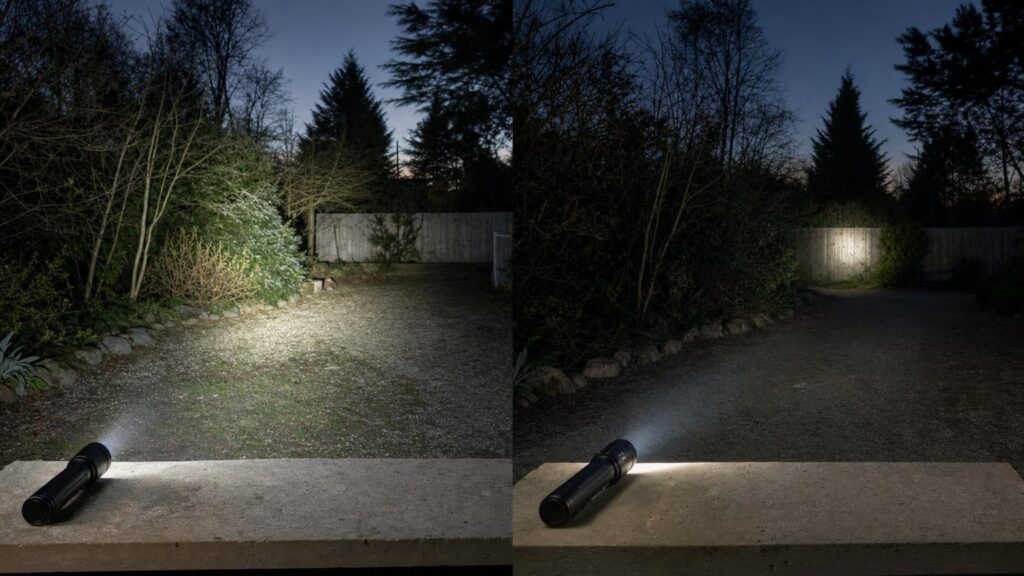
A large lumen figure is easy to compare, which is why it often dominates flashlight and torch packaging. Yet it cannot tell you how far the light will reach, how wide the illuminated area will be or how long maximum brightness will last. A high-output floodlight and a tightly focused search light may produce similar total light while behaving very differently.
To understand what a flashlight will actually do, treat it as a complete lighting system. Lumens describe total output, candela describes concentration, and the optics distribute that light into a hotspot and surrounding spill. Battery performance, driver electronics and heat regulation then determine whether the initial output can be maintained. Reading these details together is more useful than choosing the largest number.
Lumens and candela measure different things
Lumens measure luminous flux, meaning the total quantity of visible light emitted. More lumens generally means that more light is available, but the measurement does not describe where that light goes. A flashlight can distribute its output widely across a room or concentrate much of it into a narrow central beam.
Candela measures luminous intensity in a particular direction. For flashlights, the quoted figure usually represents peak beam intensity at the brightest part of the beam. Higher candela indicates that the light is more strongly concentrated, which usually supports greater reach.
Consider two flashlights with the same lumen rating. One may produce a broad, even beam that makes a garden, room or work area easy to see. The other may form a small, intense hotspot that illuminates a distant object while leaving less light around it. Their total output can be similar even though their practical uses differ substantially.
The ratio between lumens and candela can offer a rough clue about beam character. High candela relative to output often points to a concentrated, throw-oriented beam. Lower candela relative to output generally suggests a broader flood beam. It is not a complete description, however, because beam smoothness, hotspot size and spill also matter.
How candela becomes beam distance
Quoted beam distance is normally calculated from peak candela using a defined low-light threshold. Under the widely used FL 1 approach, the distance is the point at which the beam is calculated to provide a very small amount of illumination on a target. It is therefore a repeatable specification rather than a promise that a person will clearly recognise an object at that range.
This distinction matters. Detecting that something is present is easier than identifying what it is. Practical visibility is affected by target size and contrast, ambient lighting, airborne dust, mist, rain, reflective surfaces and the user’s eyesight. Light scattered by fog can also make an intense beam less useful because glare is reflected back towards the user.
Beam distance is best treated as a comparison of potential reach between lights measured on the same basis. It does not define a sharp boundary where useful illumination suddenly ends. If long-distance identification matters, look beyond the distance figure to candela, beam images from credible sources and information about how output changes after the first few minutes.
Hotspot, spill and beam profile
Most conventional flashlight beams contain several visible regions:
- Hotspot: the bright central area responsible for much of the beam’s reach.
- Spill: the wider, dimmer light surrounding the hotspot, which supports peripheral awareness.
- Transition: the area between hotspot and spill, which may be gradual and smooth or sharply defined.
A narrow hotspot usually places more intensity on a distant target, but it can feel restrictive at close range. It may also require more deliberate aiming. A wide hotspot and generous spill make it easier to see paths, shelves, equipment or an entire room, although the beam may not project as far for the same lumen output.
Beam uniformity is another consideration. Rings, dark centres, colour variation and hard edges may be irrelevant outdoors but distracting when inspecting a wall, working on machinery or using the lowest mode at arm’s length. Conversely, a perfectly even beam is not automatically better if the task requires maximum distance.
For walking, a balanced beam can be particularly helpful: enough central intensity to look ahead, combined with spill that reveals the immediate ground and surroundings. Close work generally benefits from a broad beam without an excessively bright centre, while searching over open ground favours greater intensity.
Reflectors, lenses and emitters shape the beam
The light-emitting component does not create the finished beam by itself. Reflectors and lenses collect and redirect its light, and their dimensions can matter as much as their type.
Reflectors
A reflector surrounds the emitter and directs light forwards. Larger or deeper reflectors can often concentrate light more effectively, although the result also depends on geometry and the emitter. A smooth reflector may maximise concentration but can reveal rings or other artefacts. A lightly textured reflector can blend the beam more evenly, sometimes with a softer transition around the hotspot.
Total-internal-reflection optics
Total-internal-reflection optics, commonly called TIR optics, combine refraction and internal reflection in a compact component. They can be designed for narrow, medium or broad beams, so the presence of a TIR lens does not by itself reveal whether a flashlight is a thrower or flooder. Such optics can provide controlled spill and smooth beam patterns, but their behaviour depends on the specific design.
Aspheric and adjustable lenses
An aspheric lens may be used to focus the emitter into a concentrated beam. Adjustable-focus torches can change from a broad field to a tighter projection by moving the lens or emitter. This flexibility can be convenient, but the narrow setting may produce a sharply edged image of the emitter rather than the gradual hotspot of a reflector-based design. Moving mechanisms may also add size and operational complexity.
Emitter size
The size and light-producing characteristics of the emitter influence how easily its output can be focused. A small, intense emitting surface can support high candela with suitable optics. A larger emitter may make it easier to produce substantial total output and a broad hotspot. Neither arrangement is universally superior: the useful result comes from matching the emitter and optical system to the intended beam.
Peak output versus sustained brightness
Maximum or turbo output is often a temporary operating state. Producing a large amount of light requires electrical power, and much of that energy eventually becomes heat. In a compact flashlight there is limited surface area and material available to absorb and release that heat.
Many lights therefore reduce output after becoming warm. This may happen through timed control, temperature-based regulation or a combination of the two. The change can be gradual or a noticeable step-down. A maximum figure may accurately describe initial output while saying little about what remains available after prolonged use.
Body mass, materials, surface area, airflow and ambient temperature all influence thermal behaviour. A light held in moving cold air may cool differently from the same light standing indoors. A larger body can often absorb heat for longer, but this adds weight and bulk. Compactness and sustained high output are consequently competing priorities.
Output-over-time graphs are especially valuable because they show the initial peak, any step-down and the level maintained afterwards. A lower-rated light that stabilises well may provide more useful illumination during an extended task than a higher-rated model that quickly settles at a much lower level. When graphs are unavailable, mode-specific runtime information and clear descriptions of thermal regulation provide useful context, though they do not fully describe the output curve.
Battery voltage, current and regulation
A flashlight’s performance also depends on its power source and electronic driver. Batteries with different chemistries can have different voltage characteristics even when their dimensions appear similar. Charge level, temperature, age and voltage drop under load can affect how much power is available, particularly in demanding maximum modes.
A regulated driver attempts to maintain a defined output while the battery discharges. This can provide relatively consistent brightness followed by a more obvious reduction when the battery no longer supports that level. An unregulated or less tightly regulated light may gradually become dimmer throughout its runtime. Gradual decline is not necessarily unsuitable, but it makes the initial output less representative of later performance.
Some maximum modes may only be available with a suitable high-current power source, while alternative compatible batteries may restrict output. Always follow the specified battery format, chemistry, polarity and charging instructions. Physical fit alone does not establish electrical compatibility, and cells with similar names can still have important differences.
Charging arrangements affect convenience rather than beam quality, but they belong in the overall decision. Consider whether charging occurs inside the flashlight, requires a separate charger or depends on a proprietary battery pack. Also check whether the light can operate while charging if that matters for the intended use.
Reading specifications as a complete system
A useful comparison starts with the task and then works through the specification in a consistent order:
- Review each output mode. Check whether there are practical low and medium settings rather than focusing only on maximum output.
- Compare lumens and candela. Lumens indicate total output; candela indicates peak concentration. Use both to form an initial picture of the beam.
- Interpret beam distance cautiously. Treat it as a standardised reach comparison, not guaranteed recognition distance.
- Look for beam-profile information. Hotspot width, spill and transition determine whether the beam suits close, general or long-range use.
- Examine runtime conditions. Identify the mode, battery and measurement endpoint used. A long quoted runtime may include time spent at substantially reduced output.
- Check sustained performance. Output graphs or clear regulation details can reveal what happens after the initial peak.
- Confirm the power configuration. Note included or required batteries, permitted chemistries and charging needs.
- Consider dimensions and controls. Head diameter, weight, switch layout and mode sequence can matter more in daily use than a small difference in output.
Missing information should be treated as uncertainty, not automatic evidence of poor performance. For example, the absence of a candela figure makes reach harder to compare, while the absence of an output graph leaves sustained brightness unclear. It is reasonable to give more weight to products that provide the measurements relevant to your task.
Matching beam characteristics to the task
Close work and indoor use
Prioritise broad, even illumination, useful low modes and comfortable operation. Excessive candela can create glare from pale walls or reflective surfaces, while a narrow hotspot may force constant repositioning. Runtime at low and medium settings is often more relevant than turbo output.
Walking and general household use
A balanced hotspot and spill offers versatility. The centre should provide enough reach to see ahead, while spill illuminates the immediate area. Straightforward controls, manageable size and a sensible range of modes may be more useful than extreme output at either end.
Long-range searching
Give greater weight to candela, reflector or optic size, and sustained high-mode performance. High lumens can improve the overall scene, but intensity is what places useful light on a distant target. Remember that a larger optical head may improve concentration at the cost of portability.
Extended operation
Focus on stabilised output, battery capacity, efficient medium modes and thermal behaviour. A moderate setting that can be maintained comfortably is usually more dependable than repeated use of a heat-limited turbo mode. Battery availability and charging arrangements also become more important when the light is used frequently.
Choose useful light, not the largest number
No single flashlight measurement captures brightness, reach, coverage and runtime at once. Use lumens to understand total light output, candela and beam distance to estimate concentration and reach, and beam-profile information to judge how the light is distributed. Then examine regulation, batteries and thermal behaviour to determine whether the desired output is sustainable.
The most suitable choice is the one whose beam matches the distance, field of view and operating time required. A lower maximum figure can be entirely appropriate when it comes with smoother close-range illumination, longer sustained operation or a more portable design. Reading the specifications as a connected system turns headline numbers into a practical buying decision.
Continue exploring on Frowse
Discover More Frowse Insights
- Beyond GSM: What Really Makes a Towel Absorbent, Soft and Slow to Dry
- Bypass, Anvil and Ratchet Secateurs: How to Choose the Right Cutting Mechanism
- Why Bathroom Scales Give Different Readings on Different Floors
- How an Electric Kettle Knows When the Water Has Boiled
- Roller Skate Wheels Explained: Diameter, Hardness, Profile and Hubs