





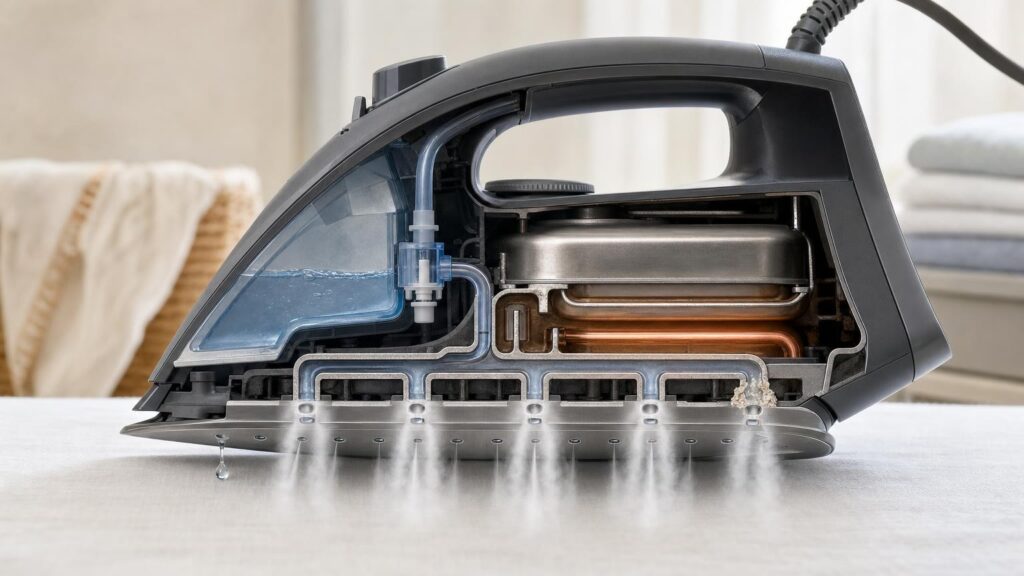
A steam iron looks simple from the outside, but its performance depends on a closely linked heat-and-water system. Water must reach a hot chamber at a controlled rate, turn into vapour and travel through the soleplate without cooling back into droplets. Temperature regulation, chamber design, vent placement, water quality and maintenance all affect how well that process works.
This is why a high steam-output figure does not tell the whole story. Consistent steam, useful distribution and manageable scale control may matter more in everyday ironing than one impressive specification.
Why steady steam is harder to produce than it looks
An iron has to balance water flow against available heat. Feed too little water into the heated area and steam output may feel weak. Feed too much, or let the temperature fall too far, and some water can remain liquid. That liquid may emerge as drips or sputtering droplets.
The soleplate also loses heat whenever it touches cooler fabric, especially damp or heavy material. Meanwhile, the temperature controller cycles the heating element to keep the iron near the selected setting. Steam production is therefore dynamic rather than perfectly constant.
A well-balanced design coordinates the water feed, heating capacity, steam chamber and vents. When comparing irons, consider how these parts are controlled rather than treating maximum steam output as a complete measure of performance.
From water tank to fabric: how an iron makes steam
Water begins in the tank and moves towards a heated chamber, usually through a controlled valve or another metering arrangement. Designs differ, so not every iron moves water in exactly the same way. Once water reaches a sufficiently hot surface inside the chamber, it vaporises. The resulting steam passes through internal channels and exits through vents in the soleplate.
Steam functions generally fall into three categories:
- Continuous or variable steam supplies vapour during normal ironing. The amount may be linked to a dial, button or automatic control.
- Steam burst sends an extra quantity of water towards the hot chamber when triggered. It is intended for short, concentrated applications rather than uninterrupted output.
- Water spray releases liquid water from a front nozzle to dampen a specific area. This is separate from the steam system and does not require the sprayed water to be vaporised first.
Some irons also permit vertical steaming, but shoppers should verify the instructions for the individual model rather than assume that every steam iron is designed for it.
Temperature control, steam settings and the causes of dripping
Traditional thermostats switch the heater on and off around the selected temperature. Electronic systems may manage temperature differently, but the underlying requirement is the same: the steam chamber must stay hot enough to vaporise the incoming water.
Low fabric-temperature settings can create a conflict. Delicate materials may require less heat, while effective steam generation requires sufficient chamber temperature. Some irons restrict steam automatically at cooler settings; others rely more heavily on the user selecting an appropriate combination.
Dripping commonly occurs when liquid water reaches the vents before it has fully vaporised. Possible causes include:
- using steam before the iron has completed its initial heat-up;
- selecting a strong steam setting while the soleplate is relatively cool;
- overfilling the tank or filling it incorrectly;
- repeatedly triggering steam bursts faster than the chamber can recover;
- allowing the iron to cool during pauses and then resuming steam immediately;
- scale or residue interfering with valves, channels or temperature sensing.
An anti-drip feature is intended to reduce unwanted water flow when temperatures are too low, but it should not be confused with a scale-removal system. It also cannot compensate for every filling, heat or maintenance problem.
Steam chambers and vents: distribution matters as much as volume
The chamber needs enough heated surface and thermal capacity to convert incoming water without being overwhelmed. Internal pathways then have to distribute vapour across the soleplate while limiting condensation. A large claimed output can be less useful if steam is concentrated in the wrong places or delivered unevenly.
Many small vents may spread steam over a broad area and help distribute it across shirts, bedding and other large items. However, vent count by itself reveals little about the underlying flow. Tiny openings can also become obstructed by deposits.
Larger openings may pass vapour and loosened particles more readily, but their position and connection to the chamber still matter. Vents concentrated near the tip can help around collars, seams, buttons and pleats. Edge coverage may be useful when approaching garment boundaries, while central coverage can support broad passes across flat fabric.
There is no universally ideal vent pattern. Someone who mainly irons large cotton garments may value even coverage, whereas detailed clothing may make tip precision more important. The useful question is not simply how many vents an iron has, but where the steam emerges and whether that suits the intended work.
What soleplate materials change – and what they do not
The soleplate influences glide, heat transfer, cleaning and resistance to wear. It does not, by itself, determine steam consistency. Two irons with similar plate materials can behave differently because of their heater control, chamber design, water metering and vent layout.
Stainless steel
Stainless-steel soleplates are generally associated with a smooth, durable surface and straightforward cleaning. Their practical performance still depends on the finish and construction. Scorched fibres, melted synthetic material and mineral residue can impair glide, and abrasive cleaning may scratch or dull the surface.
Ceramic-style surfaces
“Ceramic” commonly describes a ceramic-based or ceramic-style coating rather than a solid ceramic plate. Such surfaces may offer smooth glide and even-feeling contact when intact. The main ownership consideration is the coating: scratches, chips or wear can reduce its benefits, so cleaning methods and contact with hard garment fittings deserve attention.
Other coated or treated plates
Manufacturers may use non-stick coatings, hardened finishes or other surface treatments. These can alter glide, stain release and scratch resistance, but a material name alone does not establish long-term durability. Construction quality, coating thickness, care and the surfaces encountered during use all play a part.
Shoppers should therefore balance initial glide against likely wear. Frequent contact with zips, studs and rough fittings may make surface robustness especially relevant.
Water hardness, limescale and anti-scale systems
Water hardness describes the concentration of dissolved minerals in the supply. When water is repeatedly heated and evaporated, some minerals can remain behind as scale. Deposits may build up in the chamber, around valves and within steam channels. They can restrict flow or detach later as pale flakes and gritty particles.
Hard-water homes will generally place more demand on an iron’s scale-management system, but the correct water source is always model-specific. Some manufacturers permit tap water, some suggest a mixture under certain conditions, and some give different instructions. Distilled, demineralised, scented or treated water should not be assumed suitable unless the manufacturer allows it.
Common scale-management approaches include:
- Replaceable cartridges, which treat incoming water and create an ongoing replacement requirement.
- Removable collectors, designed to gather some mineral deposits so they can be taken out and cleaned.
- Self-clean or calc-clean cycles, which flush water, steam and loosened material through the system according to a specified procedure.
- Built-in anti-scale components, which are intended to reduce or manage accumulation but may not eliminate the need for cleaning.
These systems have different ownership trade-offs. A cartridge can make maintenance predictable but adds a consumable. A collector avoids that particular consumable but still needs attention. A cleaning cycle is convenient only if it is easy enough to perform regularly and the instructions remain available.
Why irons spit deposits or gradually lose steam
Visible symptoms can provide clues, although several causes may overlap. White or pale particles often suggest mineral scale breaking free from internal surfaces. Brown droplets can result from residue, contamination, corrosion within a deteriorating system or scorched material around the soleplate and vents. Stale water or unapproved additives may also contribute to odour and deposits.
Sputtering can occur when steam and liquid water emerge together. The iron may be insufficiently hot, the steam setting may be too aggressive for the selected temperature, or narrowed pathways may be disturbing the flow. Declining steam output can result from blocked vents, chamber scale, restricted water delivery or a control problem.
Routine cleaning may help when the cause is accessible residue or normal scale accumulation. Follow the model’s calc-clean process and soleplate-cleaning instructions rather than improvising. Persistent leakage after correct filling, heating and cleaning may point to a valve, seal or temperature-control fault. A damaged or peeling soleplate coating is also not something descaling will repair.
Ownership habits that preserve steam performance
Care begins with the product instructions because water guidance, cleaning methods and storage requirements vary. The following general habits support reliable operation when they agree with those instructions:
- Use an approved water source. Do not assume that bottled, softened or distilled water is automatically preferable.
- Respect the filling limit. Fill with the iron positioned as directed, and close the tank securely.
- Allow a complete heat-up. Wait for the ready indicator or other specified signal before demanding strong steam.
- Match heat and steam to the fabric. Check garment labels and begin with lower-temperature items if that suits the iron’s guidance.
- Give steam bursts time to recover. Rapid repeated use can temporarily exceed the chamber’s ability to vaporise water.
- Empty or store the tank as directed. This can reduce stale water and unintended leakage, although storage advice differs between models.
- Clean vents carefully. Avoid sharp tools and abrasives that could damage the soleplate or enlarge vent openings.
- Run the specified scale procedure. The appropriate interval depends on water hardness, frequency of use and the iron’s design.
Vinegar, perfume, detergent and proprietary cleaning fluids should not be poured into the tank unless the manufacturer explicitly permits them. An improvised cleaner may attack seals, leave residue or create vapours for which the appliance was not designed.
Choosing the right steam system for how you iron
For mixed fabric loads, clear temperature controls and sensible coordination between heat and steam can be more valuable than maximum output. For bedding, shirts and other broad items, look at vent coverage and sustained delivery. For collars, cuffs and pleats, tip shape and concentrated steam may matter more.
Water conditions should influence the decision too. In a hard-water area, consider whether the scale system is understandable, accessible and affordable to maintain. Check whether it uses replaceable parts and whether the recommended water is practical for your household.
Finally, choose a soleplate finish suited to expected wear and cleaning habits. Smooth glide is helpful, but so are durability and a vent layout that can be maintained. The best choice is a balanced, serviceable heat-and-water system – not simply the iron with the largest steam number or the longest list of surface features.
Continue exploring on Frowse
Discover More Frowse Insights
- Oscillating, Impact and Rotary Sprinklers: How Their Watering Patterns Differ
- Inside Flat-Pack Furniture: How Boards, Edges and Fasteners Affect Durability
- Why the Hook on a Tape Measure Is Supposed to Move
- Why a Blackout Roller Blind Can Still Leave a Room Bright
- Fan-Assisted, Convection and True Convection Ovens Explained