





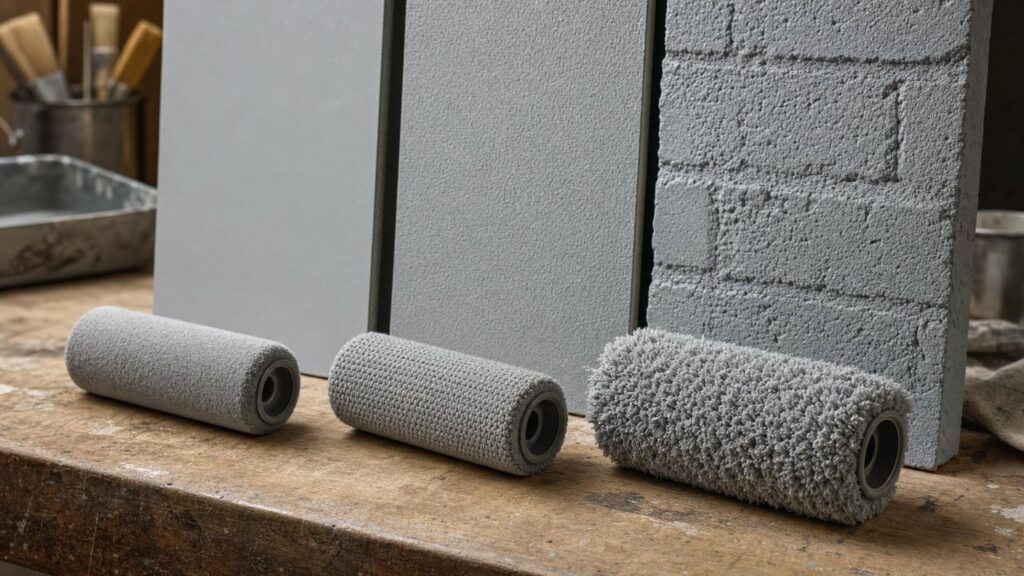
A paint roller may look simple, but its construction has a direct effect on how paint reaches the surface and how the dried finish appears. Pile depth controls contact with smooth or uneven areas, the fibre influences paint pickup and release, and the core helps the sleeve retain its shape under pressure.
The right choice is therefore not simply the roller that holds the most paint. It is the roller whose surface reach, material and construction suit the substrate, the coating and the finish you want. Understanding those relationships makes it easier to avoid pronounced stippling, splatter, loose lint and inconsistent coverage.
Why roller construction shows up in the finish
As a loaded roller moves, its fibres pick up paint, compress against the surface and spring back as they release it. The depth and behaviour of those fibres affect how evenly this happens. A soft, deep pile can carry paint into recesses, while a shorter, more controlled surface can leave a less prominent roller pattern on a flat substrate.
The core also matters. If it flexes, loses shape or fits the frame poorly, pressure may vary across the roller. Fabric attachment, seams and end construction can similarly influence tracking and the appearance of lines near the roller edges.
These factors work together. A well-made sleeve can still produce disappointing results if its pile is wrong for the wall or its material is unsuitable for the coating. Equally, a suitable roller cannot compensate fully for paint that is setting, inconsistent loading or excessive pressure.
Pile depth: balancing surface reach against finish texture
Pile, sometimes called nap, is the working layer of fibres around a roller sleeve. Shorter piles generally suit smoother surfaces because they spread a controlled film without introducing as much texture. They are often considered where a fine appearance is important, provided the coating itself is intended for roller application.
Deeper piles bend and reach into low points that a short pile might pass over. This makes them useful on rough, porous or deliberately textured surfaces. Their greater carrying capacity can also reduce how frequently the sleeve needs reloading over broad areas.
That capacity has a trade-off. A deeper pile can deposit more paint and leave a more obvious stippled pattern, especially on a smooth surface. It may also retain or redistribute excess paint rather than automatically producing better coverage. Coverage depends on the coating, substrate, loading and application technique as well as pile depth.
The practical principle is to choose the least aggressive pile that can still make effective contact with the entire surface profile. Too short and it bridges over recesses; too deep and it may sacrifice control without providing a useful benefit.
Matching pile to smooth, lightly textured and rough surfaces
Smooth surfaces
Smooth doors, cabinet panels and finely finished plaster present few recesses for fibres to enter. A shorter pile gives greater control over paint delivery and is less likely to impose a heavy roller texture. On joinery or cabinetry, however, the required finish and coating instructions are especially important. Some products may need a particular applicator or a different finishing method.
Lightly textured surfaces
Many walls have subtle texture from previous paint layers, plasterwork or the substrate itself. A short-to-medium pile can often balance reach with a reasonably restrained finish. If the pile is too short, tiny hollows may remain thin or uncoated. Repeated pressure to force the roller into them can then create uneven film thickness elsewhere.
Rough and irregular surfaces
Masonry, heavily textured walls and other uneven substrates need more fibre movement to reach their low points. A deeper pile is generally more suitable, although the exact choice should follow the coating maker’s guidance. A pile that is still too shallow may coat only the raised areas, leaving pinholes and missed recesses. On the other hand, an unnecessarily deep pile can increase splatter and surface texture while making paint distribution harder to control.
Roller fibres: how material changes loading and release
Fibre type influences how paint enters the sleeve, how readily it is released and what pattern remains. Material labels are useful, but they do not tell the whole story. Fibre density, length, backing, manufacturing quality and the specific coating all affect performance.
Woven synthetic fabrics
Synthetic roller fabrics are commonly made to offer resilience and controlled paint release. They can be suitable for a wide range of decorating tasks, particularly when the fibre and pile are matched to the coating. A dense, evenly made fabric tends to distribute paint more consistently than a sparse or irregular one. Synthetic does not automatically mean lint-free, however, and loose fibres or weak attachment can still cause shedding.
Microfibre
Microfibre sleeves use very fine synthetic fibres and can load a substantial amount of paint relative to their apparent pile. They are often chosen for even release and a comparatively refined finish, but technique remains important. Overloading a highly absorbent sleeve may create heavy deposits or splatter, and not every microfibre construction behaves identically.
Natural fibres
Natural-fibre sleeves can offer useful paint-holding and release characteristics with suitable coatings. Their compatibility should be checked carefully because fibres may react differently to the liquid in a paint. Broad assumptions based only on whether a coating is water-based or solvent-based are not enough to guarantee the right match.
Foam
Foam rollers have no conventional fibre pile and can leave a fine-looking film with certain smooth-surface coatings. They have limited ability to reach into texture, and some combinations of foam and paint may introduce bubbles or produce an uneven film. Foam composition and solvent resistance also vary, so the coating and roller makers’ instructions should guide the decision.
Paint type and roller material must work together
Paint viscosity and drying behaviour change how a roller loads and releases. A thicker coating may need enough pile and fibre flexibility to distribute it without dragging. A more fluid coating may load easily but be more prone to dripping or splatter if the sleeve carries too much.
Drying speed matters too. If paint begins to set while it is still being worked, the roller can pull at the film and leave pronounced texture or patchy sheen. A sleeve that releases paint steadily can help, but maintaining a wet edge and working within the coating’s instructions remain essential.
Water-based and solvent-based labels provide only a starting point. The liquid components of a coating can affect fibres, adhesives, foam and the roller core differently. Specialist finishes may also have very specific application requirements. Check the coating manufacturer’s recommended applicator and confirm that the sleeve is intended for that paint type rather than relying on a general material rule.
The core and end construction: less visible sources of consistency
The core is the structural cylinder beneath the fabric. It should remain round, fit the roller frame securely and resist unwanted flex during use. A distorted or loosely fitting core can wobble, track unevenly or make one part of the sleeve press harder than another.
Dimensional stability is also relevant during cleaning and reuse. A core that softens, swells or loses its shape may no longer roll consistently, even if the pile still looks serviceable. Suitability for cleaning depends on the materials and the cleaner required for the paint, so care instructions should be followed.
Inspect how evenly the fabric is attached. Raised seams, uneven pile density or loose edges can leave repeating lines. End caps should sit securely, and the sleeve should rotate without excessive lateral movement. No roller is perfectly immune to edge marks, but uniform construction makes controlled technique easier.
What causes stippling, splatter, lint and patchy coverage?
Pronounced stippling
Some roller texture is a natural result of applying paint with fibres. It becomes more obvious when the pile is deeper than the surface requires, the paint film is heavy, or the coating does not level readily. Pressing hard or going back over paint as it starts to set can make the pattern less uniform rather than smoothing it.
Splatter
Splatter commonly increases when a roller is overloaded or moved too quickly. A deep pile holding a fluid coating can exaggerate the problem, but pace and loading are often as important as roller construction. Distribute paint through the sleeve before moving to the wall and use steady passes rather than rapid flicking motions.
Lint and loose fibres
Fibres in the finish may come from loose manufacturing debris, a low-integrity fabric or a sleeve that is worn or damaged. Removing loose fibres before first use, where the maker recommends it, can help. Persistent shedding during use is a reason to stop and replace the sleeve rather than continuing to embed lint in wet paint.
Patchy or uneven coverage
Thin areas can result from inadequate loading, a pile that cannot reach the surface texture, or continuing to roll after the sleeve has released most of its paint. Heavy patches may come from overloading or inconsistent pressure. Irregular overlap and returning to partly set paint can also cause visible differences in texture or sheen.
Pressing harder is rarely a good substitute for reloading. Excess pressure compresses the fibres, can push paint towards the roller edges and may leave ridges. The sleeve should do the carrying and releasing, with the user applying only enough pressure to maintain even contact.
Choose for the finish you want, not just the surface you have
Surface texture establishes the minimum reach needed, but the desired finish determines how much additional texture is acceptable. For a broad, rough wall, carrying capacity and recess coverage may matter more than a subtle stipple. For a smooth feature surface, control and a restrained roller pattern may take priority over the speed gained from holding more paint.
Consider these factors together:
- Surface profile: Identify whether the substrate is genuinely smooth, lightly textured or deeply irregular.
- Coating instructions: Check the recommended roller material and pile rather than assuming all paints of one broad type behave alike.
- Finish expectations: Decide how much roller texture is acceptable and whether the coating is designed to level after application.
- Area and working pace: A higher-capacity sleeve may help on large areas, but only if paint can be applied evenly while maintaining a wet edge.
- Control: Fine-finish work usually rewards measured loading and a suitable shorter pile rather than maximum paint capacity.
Preparation, first use and cleaning affect performance
Before painting, inspect the sleeve for uneven fabric, damaged ends or a distorted core. Follow its preparation instructions. Some fabric sleeves benefit from having loose surface fibres removed before first use, while foam and specialist rollers may require different handling.
Load paint across the full width of the sleeve using a suitable tray, bucket grid or scuttle. Work the paint into the pile without submerging the core unnecessarily, then remove the obvious excess. During application, reload before the roller begins to run dry and overlap passes consistently while the adjacent paint remains workable.
Clean reusable sleeves according to both the paint and roller makers’ instructions. The appropriate method depends on the coating and sleeve materials. Avoid storing a cleaned roller while it is crushed or misshapen. A sleeve should be replaced when its pile remains matted, the core is distorted, the ends are loose, it rolls unevenly or it continues shedding fibres.
A confident final check before choosing
Start with the surface profile, then confirm what applicator the coating manufacturer recommends. Select the least aggressive pile that will still reach the texture, and choose a fibre whose loading and release behaviour support the intended finish. Finally, inspect the sleeve for uniform pile, secure fabric, sound ends and a rigid, well-fitting core.
The most effective roller is not necessarily the deepest, softest or most absorbent. It is the one that delivers the required coating evenly, reaches the substrate without unnecessary texture and remains stable enough to make consistent technique possible.
Continue exploring on Frowse
Discover More Frowse Insights
- Why the Number on a Toaster Dial Usually Is Not Minutes
- Why a Washing Machine’s Kilogram Capacity Is Not the Size of Every Load
- Why a “High-Pressure” Showerhead Cannot Create More Water Pressure
- Inside Flat-Pack Furniture: How Boards, Edges and Fasteners Affect Durability
- Why Scissors Stop Cutting Even When the Blades Still Feel Sharp