





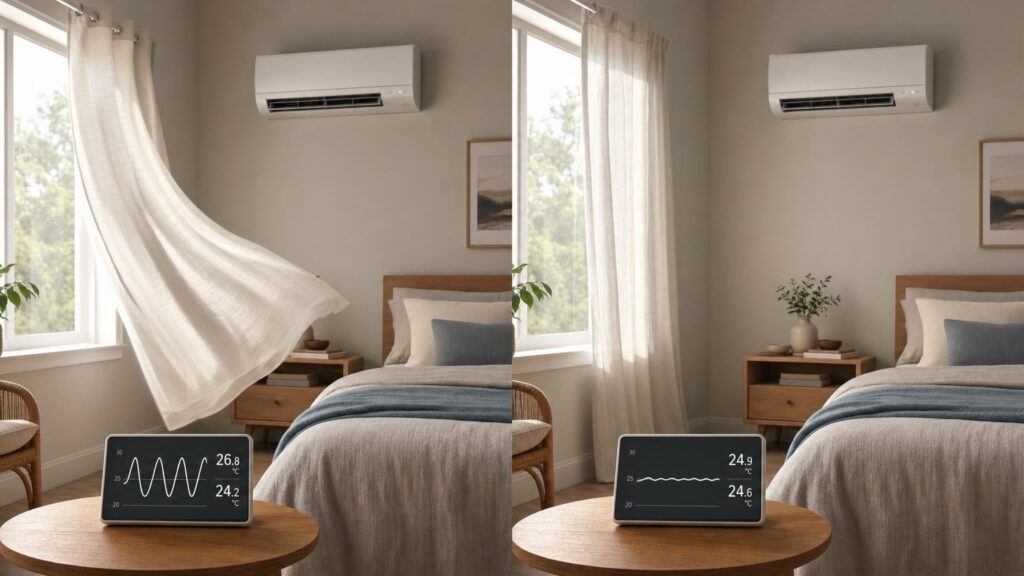
Two room air conditioners can have the same nominal cooling capacity yet feel noticeably different in use. One may alternate between strong bursts of cooling and quiet pauses, while another may run for long periods at a gentler output. Their temperature stability, sound character, moisture removal and electricity consumption can also differ.
The reason is that rated capacity mainly describes how much cooling a unit can deliver under specified test conditions. It does not fully describe how the system responds when the room needs only part of that output. Compressor control – particularly the difference between fixed-speed cycling and inverter modulation – is therefore an important buying consideration.
Fixed-speed cycling versus inverter modulation
A conventional fixed-speed compressor generally has two basic operating states: running and stopped. When the thermostat detects that the room is warmer than the set temperature, the compressor starts and delivers cooling. Once the control system decides that sufficient cooling has been provided, it stops. This cycle repeats as heat enters the room.
The term fixed-speed does not mean the entire air conditioner lacks control. The indoor fan may offer several speeds, sensors still measure temperature, and the thermostat determines when cooling is required. However, the compressor itself usually cannot reduce its output gradually to match a small load.
An inverter air conditioner uses power electronics to vary compressor speed. It may begin at a relatively high output to bring a warm room towards the set temperature, then slow down as demand falls. Instead of repeatedly providing full output and stopping, it can often continue operating at a lower level.
This distinction is important, but the inverter label is not a complete measure of performance. Sensors, control software, fan behaviour, heat-exchanger design and the available compressor speed range all influence how effectively a unit modulates.
Rated capacity, real cooling demand and part-load operation
Air conditioners are commonly compared by rated cooling capacity. Capacity matters because a unit must be able to remove heat quickly enough during demanding conditions. But a room rarely needs its maximum design cooling load continuously.
Demand changes with outdoor temperature, direct sunlight, time of day, occupancy, lighting and heat-producing appliances. Building insulation, window size, air leakage and whether neighbouring spaces are conditioned also affect the load. After a room reaches its target temperature, the air conditioner generally needs only to offset the heat entering it.
This is called part-load operation. A unit with enough capacity for a hot afternoon may need a much smaller output in the evening or during milder weather. A fixed-speed system addresses this mismatch primarily by changing how long it runs and how long it remains off. An inverter system can also change its instantaneous output.
Consequently, two models with the same headline capacity may behave differently for most of their operating hours. Rated capacity tells shoppers whether a unit can potentially meet a substantial load; it does not show how closely that unit can follow smaller, fluctuating loads.
Minimum output and the limits of modulation
Inverter compressors cannot normally reduce their output without limit. Every system has a lowest useful operating level, sometimes described as its minimum capacity or minimum turndown. Below that point, stable or efficient compressor operation may not be possible.
If the room requires less cooling than the minimum output, an inverter unit may still cycle off and on. For example, an oversized inverter air conditioner in a small room could reach its lowest output yet continue cooling faster than heat enters the space. The controller must then stop the compressor to avoid overcooling.
Where published consistently, the difference between rated and minimum cooling output can reveal more than the inverter label alone. A broad modulation range may help a unit remain running during modest demand. However, minimum figures are not always provided, and values from different test methods or operating conditions may not be directly comparable.
Maximum capacity also deserves context. Some inverter units can temporarily operate above their nominal rating under particular conditions, but shoppers should not assume that this output is sustainable in every climate or operating mode. Rated, minimum and maximum figures each describe different aspects of performance.
What cycling and modulation mean for comfort and noise
Frequent fixed-output cycles can produce more noticeable temperature changes. Air near the unit may become cool while the compressor runs, then gradually warm during the off period. The effect depends on thermostat sensitivity, sensor location, fan settings, room layout and the amount of excess capacity.
Modulation can support steadier temperatures by reducing output as the set point approaches. Longer operation at lower output may also create gentler air movement than repeated high-output bursts. This can be valuable in bedrooms, offices and other spaces where occupants remain in one place for long periods.
Noise is more complicated than a simple fixed-speed versus inverter comparison. A modulating compressor may spend much of its time at a quieter, lower speed and avoid some abrupt starts. On the other hand, it may run for longer, creating a continuous background sound. Changes in compressor frequency can also alter the tone of the outdoor unit.
Indoor fan noise, airflow turbulence, cabinet vibration and installation quality can be just as important as compressor type. Published sound levels are useful only when their test conditions and operating modes are understood. A low figure for a quiet fan setting does not necessarily describe sound at maximum cooling output.
Humidity control is about run time, coil temperature and airflow
An air conditioner removes moisture when humid air passes over an indoor coil that is cold enough for water vapour to condense. The resulting water must then drain away. Effective dehumidification therefore depends on coil temperature, airflow, run time and the moisture load in the room.
Short cooling cycles can limit moisture removal because the compressor may stop soon after the coil becomes cold. Longer operation at a suitably low output can provide more continuous contact between room air and the cold coil, potentially supporting steadier humidity control.
However, modulation does not automatically mean superior dehumidification. At very low loads, a control strategy might raise the coil temperature or increase airflow in a way that reduces condensation. Continuing to run the indoor fan after the compressor stops can also return some retained moisture to the room, depending on the system design.
Humid climates and spaces with high latent loads require particular attention. A substantially oversized unit may lower air temperature quickly but spend too little time removing moisture. Where humidity performance matters, look for credible moisture-removal information, a dedicated dry mode and an explanation of how that mode operates. Dry mode is not a substitute for correct sizing, and its behaviour varies by model.
Start-up demand and electrical considerations
Compressor start-up demand is different from total electricity consumption. A traditional compressor starting directly at fixed speed can draw a brief surge as it begins operating. This event may occur repeatedly when the system cycles.
Inverter electronics typically allow the compressor to ramp up rather than making the same type of repeated direct start. That can reduce abrupt start-up demand, but it does not establish the unit’s overall electrical requirements or guarantee suitability for a particular circuit.
Power supply voltage, maximum input, plug or connection type, protective devices and installation rules must all be checked for the specific product and location. Portable, window, split and multi-split systems have different installation considerations. Some products require professional electrical and refrigerant work. Shoppers should rely on the manufacturer’s technical documentation and applicable local requirements rather than inferring compatibility from the word inverter.
Efficiency claims need to reflect changing loads
A single full-load efficiency figure describes performance at a defined operating point. It may not represent how the air conditioner performs across a season of changing temperatures and cooling demands.
Seasonal efficiency measures attempt to account for operation at several loads or conditions, making them potentially more informative for typical use. The terminology and calculation methods differ between regions, however, so values based on different standards should not be compared as though they were identical.
Modulation can improve part-load efficiency by reducing avoidable cycling and allowing the system to operate closer to the room’s current demand. A compressor running at reduced speed may also operate more efficiently than one repeatedly starting, stopping and returning to full output.
Nevertheless, an inverter is not automatically cheaper to run than every fixed-speed alternative. Heat-exchanger size, compressor design, fan power, standby consumption, controls and climate all contribute. User behaviour matters too. Set temperature, operating hours, open doors, dirty filters and unrestricted sunlight can outweigh modest differences between technologies.
For realistic comparison, consider seasonal efficiency under the relevant local standard, rated input power, capacity at demanding conditions and any available part-load data. These indicators provide context, but an energy label or laboratory rating still cannot predict an exact household bill.
Sizing and specifications to compare before choosing
Correct sizing begins with the room’s heat load, not floor area alone. Room size is a useful starting point, but ceiling height, orientation, glazing, insulation, shading, occupancy and local climate can significantly change the required capacity. Kitchens, home offices and rooms with heat-producing equipment may need additional allowance.
An undersized unit may run continuously without reaching the desired temperature during hot conditions. An oversized fixed-speed unit may satisfy the thermostat quickly and then cycle frequently. An oversized inverter system may manage moderate excess capacity better, but it will still cycle if demand falls below its minimum output.
When comparable information is available, consider:
- Rated cooling capacity: Indicates the principal cooling output under stated test conditions.
- Minimum cooling output: Helps show how far an inverter system can reduce capacity before cycling may become necessary.
- Operating temperature range: Indicates the outdoor conditions within which the manufacturer specifies operation, though capacity may change across that range.
- Seasonal efficiency: Offers a broader view than a single full-load efficiency figure when products use the same regional test standard.
- Indoor and outdoor sound levels: Check the associated fan speed and operating mode rather than comparing headline numbers alone.
- Moisture-removal information: Useful in humid conditions, but results depend on the stated temperature, humidity and test method.
- Electrical specifications: Confirm rated and maximum input, supply requirements and installation needs.
- Air distribution controls: Fan range, louvre movement and sensor placement can affect comfort throughout the room.
Installation also shapes the result. A split system needs appropriate indoor and outdoor unit placement, correct refrigerant work and effective condensate drainage. Portable units need a suitable exhaust arrangement, while window units require secure fitting and adequate sealing. Poor installation can undermine comfort, noise and efficiency regardless of compressor technology.
Choose for the load profile, not the label
Variable output is most valuable when an air conditioner will run for long periods across changing or modest loads. In those conditions, a well-designed inverter system may maintain steadier temperatures, avoid repeated full-output starts and deliver stronger part-load efficiency.
A fixed-speed model may still be reasonable where cooling is occasional, loads are comparatively consistent or purchase simplicity is the priority. Its suitability depends on correct sizing and credible performance information rather than technology labels alone.
The most useful comparison combines room heat load, rated capacity, minimum output, seasonal efficiency, sound data, humidity needs and installation requirements. Nominal cooling capacity tells only part of the story, and the word inverter does not guarantee quiet, continuous or economical operation. How well the whole system matches the room is what ultimately determines comfort and consumption.
Continue exploring on Frowse
Discover More Frowse Insights
- What Determines How Long a Cool Box Stays Cold?
- Why Floating Floors Need Expansion Gaps – and What Happens When They Cannot Move
- Why an HDR Badge Does Not Guarantee a Convincing HDR Picture
- Why the Hook on a Tape Measure Is Supposed to Move
- Why Noise-Cancelling Headphones Work Better on Some Sounds Than Others