





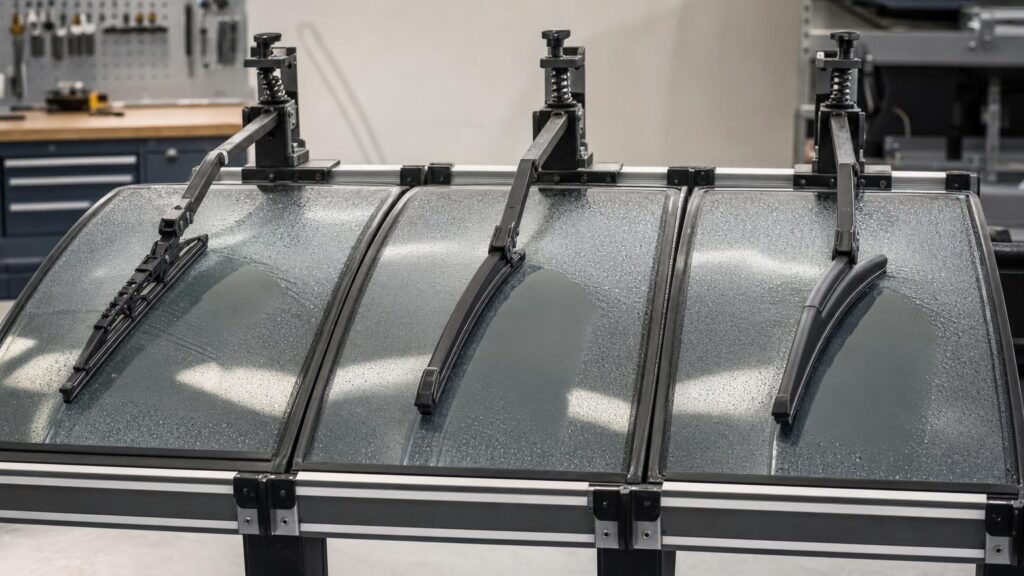
Wiper blades are often presented as a simple progression from conventional to hybrid to beam construction. In practice, those labels describe different ways of transferring the wiper arm’s force to a narrow rubber edge. The best choice is therefore not automatically the newest-looking or most expensive design. It is the blade that maintains suitable contact across the particular shape of the windscreen.
Construction also affects how a blade deals with airflow, dirt, ice and wear. Understanding the differences makes it easier to assess fit, diagnose a poor wipe and decide whether to replace an insert or the complete blade.
The parts that actually meet the glass
The visible blade body does not itself clear the windscreen. That work is done by a flexible rubber wiping edge. As the arm changes direction, the edge should flex or flip so that it trails across the glass. If it becomes hard, split, distorted or contaminated, it may leave lines, smear water or make noise.
Behind the rubber, backing strips or spring rails control its shape. These components help keep the wiping edge supported while allowing the blade to follow a curved screen. Conventional blades usually use narrow rails within the rubber profile plus an articulated frame above them. Beam blades use pre-curved spring elements as the main supporting structure. Hybrid designs normally place a shaped cover around an articulated support system.
The blade does not create its own downward force. A spring-loaded wiper arm presses the assembly towards the glass, while the blade structure distributes that force along its length. Effective wiping depends on several elements working together:
- Wiping edge: removes water and loose contamination from the glass.
- Rubber profile: allows the edge to flex while holding it in a controlled position.
- Rails or backing strips: support the rubber and influence how it follows the windscreen.
- Frame joints or spring elements: spread arm pressure from the central connector towards both ends.
- Wiper arm: provides pressure and guides the blade through its arc.
A blade can therefore be the correct nominal length yet perform poorly if its curvature, connector or pressure distribution is unsuitable.
Conventional blades: articulated pressure points
A conventional wiper has an exposed frame made from metal, plastic or a combination of materials. The arm presses near the centre of the blade, and a series of linked bridges and claws spreads this force to several points along the rubber insert. The joints allow sections of the assembly to move as the blade travels across changing windscreen curvature.
This familiar design can work well when the blade geometry matches the screen. Its structure is easy to understand, and some conventional blades permit replacement of the rubber refill rather than the entire assembly. The open frame may also make it easier to see whether an insert has slipped out of position or a support rail has been installed incorrectly.
However, pressure is delivered through distinct contact points rather than through one continuous spring element. Wear, corrosion, dirt or stiffness at a joint can stop the frame articulating freely. One area may then receive too much pressure while another lifts slightly, causing unwiped patches or streaks.
The exposed frame provides places where leaves, grit, snow or ice can collect. Loose joints can contribute to movement and noise, while the relatively tall structure may be more exposed to airflow. These are possible trade-offs rather than proof that every conventional blade will perform poorly.
Beam blades: continuous spring tension
A beam blade does not use the external bridge-and-claw frame found on a conventional design. Instead, one or more pre-curved spring rails run through or alongside the rubber assembly. Their stored tension helps the blade conform to the glass and distributes pressure more continuously along its length.
The curvature and stiffness of those rails matter. A beam blade is not simply a flexible strip that adapts perfectly to any windscreen. If its spring profile is poorly matched to the glass, the centre or ends may not remain in suitable contact throughout the wiping arc. This is particularly relevant on windscreens with pronounced or changing curvature.
With fewer exposed joints, a beam blade offers fewer spaces for debris or winter build-up to obstruct articulation. Its low-profile body can also present a smoother shape to passing air. Many beam designs incorporate a spoiler directly into the casing or rubber profile.
These characteristics do not guarantee a quieter or cleaner wipe. Rubber condition, glass contamination, arm alignment and fitting accuracy still matter. A correctly matched conventional blade can outperform an unsuitable beam blade on a given vehicle.
Hybrid blades: framed support under a shaped shell
Hybrid blades are sometimes confused with beam blades because both can have a smooth outer appearance. A typical hybrid design retains an articulated support structure but covers much of it with a shaped shell. Pressure is still distributed through frame sections and contact points, rather than solely through a continuous pre-curved beam.
The cover can shield parts of the frame from dirt, ice and direct airflow. It may also form an aerodynamic profile that helps the blade remain settled against the screen. Underneath, the articulated structure continues to accommodate curvature in a way similar to a conventional blade.
This combination may suit shoppers who want framed support with fewer exposed components. The trade-off is that the assembly can be bulkier, and the cover may make the underlying joints less visible when checking for damage or obstruction. As with the other types, the label alone reveals little about whether its particular geometry suits a specific windscreen.
Spoilers, airflow and high-speed contact
Airflow can influence a wiper blade, especially where its body presents a broad face to oncoming air. A spoiler is shaped to use that airflow to press the blade towards the glass or to reduce forces that could encourage lift. It may be attached to a conventional frame, integrated into a beam blade or formed by a hybrid cover.
Some spoilers are asymmetric and designed to face a particular direction. Installing the blade backwards, or fitting a left-hand blade where a right-hand version is required, can place the aerodynamic surface incorrectly. Driver and passenger blades may also differ in length, curvature or spoiler orientation even when their connectors look similar.
A spoiler is only one part of the system. It cannot correct a loose adapter, badly worn rubber, a twisted wiper arm or insufficient arm pressure. Aerodynamic styling should therefore come after fit and contact in the buying decision, not before them.
Fit is more than matching blade length
Blade length is an important specification, but it is not enough to establish compatibility. Vehicles use several wiper-arm endings and connector arrangements. A replacement may have a dedicated connector or a multi-fit body supplied with separate adapters. The adapter must match the arm and lock securely without forcing, excessive movement or interference with the blade body.
Before buying, verify the vehicle’s model, year and relevant body style or generation. Also check which blade position is being replaced. Front blades can be different from each other, while rear wipers often use distinct lengths, connectors and integrated arm designs.
Useful fit checks include:
- the specified length for each position;
- the exact wiper-arm and connector type;
- whether the blade is position-specific or directional;
- spoiler orientation when the vehicle is parked;
- clearance from the windscreen edge, trim and the other blade;
- whether any supplied adapter is required and correctly seated.
After installation, the blade should pivot freely on its connector and sit naturally against the glass. If it appears twisted or one end remains raised, recheck the adapter and orientation before assuming the construction is unsuitable.
Refills, replacement blades and ownership trade-offs
A refill replaces the rubber insert while retaining the existing frame or blade structure. This can reduce the number of parts replaced, but compatibility is more specific than matching the visible width of the rubber. The refill’s profile, retaining features, length and relationship with its backing rails must all suit the original blade.
Some refills require metal or spring strips to be transferred from the old insert. Their orientation and position affect how the rubber sits in the frame. Retaining clips must also be secured correctly so the refill cannot slide along the blade. If trimming is permitted for a particular refill, it should be done only according to its fitting instructions.
Replacing the complete blade is generally more straightforward because the rubber, support structure and connector are supplied as an assembly. It also avoids retaining an old frame with stiff joints, corrosion or worn claws. On a beam blade, ageing or damaged spring elements may continue to cause poor contact even if new rubber could be installed.
The practical decision depends on whether a compatible refill is available, whether the existing structure is in good condition and how confident the installer is about transferring rails and securing the insert. Refillability is useful only when the remaining assembly still distributes pressure properly.
Diagnosing streaking, skipping and chatter
Poor wiping does not always mean that the blade type is wrong. A simple check sequence can help separate contamination and installation problems from wear or design mismatch.
- Clean the glass. Road film, wax, grease and residues from some screen products can cause smearing or make the edge move inconsistently.
- Inspect and clean the rubber. Look for splits, flat spots, deformation or embedded debris. Use an appropriate cleaning method rather than sharp tools or aggressive chemicals.
- Check the installation. Confirm that the connector is locked, the adapter is correct and the blade faces the intended direction.
- Observe the contact pattern. Persistent missed areas at an end or in the centre can indicate unsuitable curvature, a restricted frame joint or a problem with the arm.
- Examine the arm. A visibly twisted or damaged arm can hold the rubber at the wrong angle. Weak spring pressure may also prevent consistent contact.
- Consider operating conditions. Wiping a dry or only lightly damp screen can promote skipping and noise. Frozen blades should not be expected to articulate normally.
Chatter often occurs when the rubber edge does not flip smoothly at each change of direction. Possible causes include hardened rubber, contaminated glass, an incorrect blade angle or friction from a screen treatment. A rhythmic knock may instead indicate excess play, an obstruction or contact with trim or another blade.
If cleaning and refitting do not help, replacement may be appropriate. If several correctly fitted blades show the same missed area, the arm or wiper mechanism may deserve attention rather than repeated blade changes.
Choose for contact, fit and conditions
Conventional, beam and hybrid blades use different structures to distribute the wiper arm’s pressure. Conventional frames rely on articulated pressure points, beam blades use pre-curved spring tension, and hybrid blades usually place an aerodynamic shell over a framed support system. None is universally superior on every windscreen.
Start with verified dimensions, position and connector fit. Then consider the windscreen’s curvature, exposure to debris or winter build-up, airflow, refill preferences and ease of inspection or maintenance. Above all, judge a blade by whether it keeps a sound rubber edge evenly supported against the glass throughout the wiping arc.
Continue exploring on Frowse
Discover More Frowse Insights
- Why the Number on a Toaster Dial Usually Is Not Minutes
- Why Mechanical Pencil Leads of the Same Diameter Perform Differently
- How to Choose a Portable Air Conditioner for an Australian Summer
- Porcelain, Stoneware and Earthenware: What the Names Really Mean
- Why More Ceiling-Fan Blades Do Not Automatically Mean More Airflow