





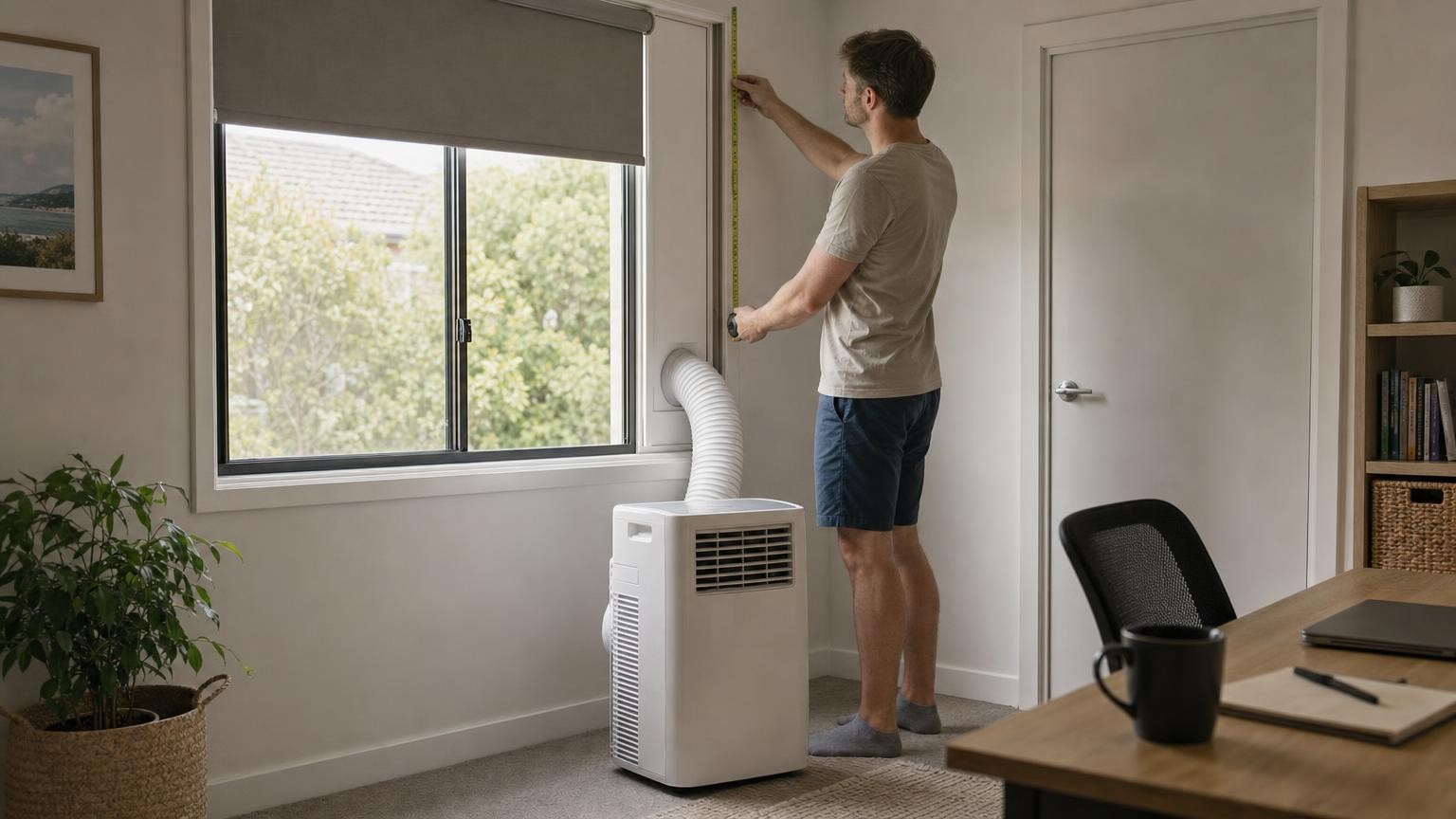
A portable air conditioner can provide targeted relief when a fixed system is unavailable or impractical. However, it is best treated as a room-specific appliance rather than a substitute for whole-home air conditioning. Its effectiveness depends as much on the room and installation as it does on the unit itself.
Before comparing features, consider the space you intend to cool, how much heat enters it, whether it can be closed off, where the exhaust hose will go and how much noise you can accept. These practical questions will usually narrow the choice more effectively than a long feature list.
Start with the room, not the appliance
Portable air conditioners work most effectively in an enclosed room. If doors remain open to hallways or adjoining spaces, the unit must continually deal with warm replacement air and a larger effective cooling area. Open-plan living areas can therefore be challenging, particularly when connected to kitchens, stairwells or other warm zones.
Assess how the room behaves during hot weather. A shaded ground-floor bedroom may have a much lighter cooling load than an upstairs room of the same floor area with west-facing glass. Important factors include ceiling height, insulation, roof exposure, window size, direct afternoon sun and the number of people commonly using the room.
Local conditions matter too. Hot, dry inland weather creates different demands from warm, humid coastal weather. Humidity affects comfort and the quantity of condensate produced, while intense solar exposure can make a room difficult to cool even when its dimensions appear modest.
Finally, decide what outcome you need. Cooling a bedroom before sleep is different from maintaining a comfortable home office throughout the day. The intended use affects the importance of operating noise, timers, drainage and energy consumption.
Understand what “portable air conditioner” means
A compressor-based portable air conditioner cools room air using a refrigeration cycle and transfers the unwanted heat outdoors through an exhaust hose. Despite the word “portable”, it still needs access to a suitable window or other approved opening. It cannot cool effectively if the hot exhaust remains inside the room.
This is different from an evaporative cooler, which passes air through water-wetted material. Evaporative models do not use the same refrigeration process and are generally more dependent on dry conditions and fresh airflow. Their performance can be limited in humid weather because the air is already carrying substantial moisture.
A fan does not lower room temperature. It moves air across the body, which can make occupants feel more comfortable. A dehumidifier removes moisture and may improve comfort in humid conditions, but it releases heat into the room and is not a replacement for air conditioning.
Check the product description carefully rather than relying on terms such as “air cooler”. Look for a stated cooling capacity, refrigerant-based operation and an exhaust hose or window kit if you want true portable air conditioning.
Match cooling capacity to the actual heat load
Cooling capacity is commonly expressed in kilowatts. A higher capacity indicates a greater ability to remove heat, but floor area alone does not determine what is suitable. Room-size guides can be a useful starting point, yet they cannot account for every building or climate variable.
Consider the factors that increase the real heat load:
- High ceilings, which increase the volume of air in the room
- Large, unshaded or west-facing windows
- Poor insulation or substantial roof exposure
- Open doorways and gaps that allow warm air to enter
- Several occupants using the room at once
- Computers, televisions, cooking appliances or other sources of heat
- Frequent door opening or strong afternoon sun
An undersized unit may run continuously without reaching the chosen temperature, especially during the hottest part of the day. This can mean more noise, limited comfort and long operating periods.
Buying the largest available unit is not automatically the answer. A bigger model may be heavier, noisier, more expensive and less convenient to vent or store. It may also be unnecessary for a small, well-shaded room. The goal is to choose enough capacity for the room’s credible peak heat load without adding bulk and power demand that serve no practical purpose.
When comparing capacity guidance, use the manufacturer’s stated assumptions where available and adjust your judgement for sunlight, ceiling height and insulation. If the room cannot be isolated from a much larger space, recognise that a nominal room-size rating may not reflect the actual task.
Choose between single-hose and dual-hose designs
Single-hose units
A single-hose portable air conditioner draws air from the room, uses some of it to carry heat away and sends that heated air outdoors. Removing indoor air can create slightly lower pressure in the room, encouraging warmer replacement air to enter through door gaps and other openings.
Single-hose models are often simpler to install because only one duct must be routed to the window. They can also be less bulky. Their real-world effectiveness depends heavily on good sealing and keeping the conditioned space closed.
Dual-hose units
A dual-hose design typically uses one hose to draw in outside air for the heat-exchange process and another to exhaust heated air. This can reduce the amount of cooled room air sent outside and limit warm replacement air being pulled into the room.
The trade-offs are additional hose bulk, a larger window-panel requirement and potentially more installation complexity. Dual-hose designs may also be less readily available in some ranges. Neither arrangement is universally best: compare capacity, physical fit, noise and installation quality rather than choosing on hose count alone.
Check whether the room can be vented properly
Window compatibility should be confirmed before purchase. Sliding windows are often straightforward because an adjustable panel can fill the open section. Vertically opening sash windows may accept a similar panel in a different orientation. Awning and casement windows can require a compatible fabric seal, insert or other installation method approved for the appliance.
Measure the window opening as well as the available space around it. Check the supplied panel’s adjustment range, the exhaust-hose diameter and the size of its connectors. A kit that is too short, too wide or incompatible with the opening can turn a seemingly simple purchase into a difficult installation.
Seal gaps around the panel so hot outdoor air does not flow straight back into the room. The hose should take the shortest practical route, with gentle bends and enough clearance for unrestricted airflow. Extending it beyond the manufacturer’s arrangement or introducing sharp bends can increase resistance and allow more heat to radiate back into the room.
Renters should consider whether the installation can be removed without altering the window frame. Also think about security: a partially open window or removable panel should not leave the property vulnerable. If a secure installation is not practical, the room may not be suitable for this type of appliance.
Account for humidity and condensate
As an air conditioner cools humid air, moisture can condense inside the unit. What happens to that water varies by design and by operating conditions. Some models evaporate much of the collected moisture into the exhaust stream during normal cooling, while others use an internal tank or offer one or more drain ports.
Do not assume that a “self-evaporating” description means drainage will never be required. During humid weather, the unit may collect water faster than it can expel it. Check how the appliance indicates a full tank and whether emptying requires moving the unit or accessing a low drain point.
Continuous drainage can be convenient, but water generally needs a suitable destination and an appropriate hose arrangement. A low drain outlet may be difficult to use if the nearest drain is higher. Dehumidifying modes can also produce more collected water than ordinary cooling, so check the instructions for that mode separately.
Compare noise, controls and day-to-day comfort
Portable air conditioners contain a compressor and fan within the room, so they are typically more noticeable than systems whose main mechanical components are outdoors. A headline sound figure is helpful for comparison, but it does not describe every aspect of the experience.
Compressor cycling, changes in fan speed, vibration and the pitch of the airflow can all affect perceived noise. This is particularly important in bedrooms, nurseries, study areas and rooms used for video calls. A firm, level floor can help prevent unnecessary vibration, while clearance from furniture can reduce rattling and airflow obstruction.
Prioritise controls that match how you will use the appliance:
- Thermostatic control helps the unit respond to a selected temperature rather than simply running at one setting.
- Multiple fan speeds provide a choice between faster cooling and quieter airflow.
- Timers can start or stop operation around sleep or work schedules.
- Sleep settings may reduce fan speed or alter temperature control, although operation varies by model.
- Directional airflow helps distribute cooled air without directing a strong draught at one person.
- Remote operation is useful when controls are difficult to reach, especially at night.
More modes are not inherently better. Clear controls and settings you will actually use matter more than an extensive feature list.
Plan for power use, placement and ongoing ownership
Stated input power and energy information provide a basis for comparison, but actual consumption depends on operating time, thermostat setting, outdoor conditions and the room’s heat load. Improving curtains, blinds, door seals and shading can reduce the work the appliance must do.
Confirm that a suitable power outlet is within reach of the supplied cable and follow the manufacturer’s electrical instructions. Do not assume that an ordinary powerboard or extension lead is appropriate. The chosen position must also leave the specified clearance around air inlets and allow an unobstructed exhaust route.
Although portable units have wheels, they can be heavy and awkward to move across thresholds, carpet or stairs. Consider where the appliance will live during summer and where it will be stored during cooler months. If it will move between rooms, each room needs a workable venting arrangement rather than just a nearby outlet.
Routine maintenance usually includes cleaning the air filters and checking the hose, window panel and drainage system. Before seasonal storage, drain any remaining water, allow appropriate components to dry and store the hose and fittings together. It is also worth checking whether replacement window-kit components and connectors can be obtained if parts are lost or damaged.
Use a final room-by-room checklist
- Define the space: Confirm that the room can be closed off from larger adjoining areas.
- Assess the heat load: Consider floor area, ceiling height, windows, sunlight, insulation, occupants and heat-producing equipment.
- Check capacity: Compare the stated cooling output with guidance appropriate to the room, then account for difficult conditions.
- Choose the airflow design: Weigh single-hose simplicity against the potential airflow advantages and added bulk of a dual-hose arrangement.
- Verify the window fit: Measure the opening, panel range, connectors and hose route before buying.
- Plan for water: Understand tank emptying, self-evaporation claims, drain-port access and dehumidifying-mode requirements.
- Consider daily comfort: Decide whether the noise character, controls and airflow suit sleeping, working or general living.
- Confirm ownership requirements: Check outlet access, placement clearance, filter maintenance, mobility and seasonal storage.
The best portable air conditioner is not simply the model with the highest capacity or longest feature list. It is one that matches the room’s heat load, vents securely through the available opening and remains practical to operate, drain, clean and store. Taking measurements and planning the installation first can prevent many of the compromises that limit portable cooling in an Australian summer.
Continue exploring on Frowse
Discover More Frowse Insights
- Why an HDR Badge Does Not Guarantee a Convincing HDR Picture
- Why Replacement Toilet Seats So Often Fit Poorly
- How an Electric Kettle Knows When the Water Has Boiled
- AGM, EFB and Flooded Car Batteries: Why the Right Size Is Not Enough
- Phillips, Pozidriv and JIS: Why Cross-Head Drivers Are Not Interchangeable